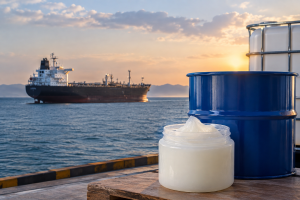

Persian Gulf Sea Blockade: Impacts On Petroleum Jelly Supply in 2026
The Persian Gulf has always been one of the world’s most important maritime regions for international trade. In 2026, however, increasing restrictions, attacks on commercial vessels, and disruption around the Strait of Hormuz have created a new challenge for companies that depend on maritime transportation.
For industries that import petroleum-based raw materials, the consequences go beyond the energy sector.
Petroleum jelly manufacturers, cosmetic companies, pharmaceutical producers, and industrial buyers can also be affected when shipping routes become uncertain.
What Is Happening in the Persian Gulf?
The current situation around the Persian Gulf and Strait of Hormuz has significantly reduced normal maritime traffic.
On September 10, preliminary vessel-tracking data recorded only seven transits through the Strait of Hormuz, compared with an average of roughly 125 commercial vessels per day before the current conflict began.
The International Maritime Organization has also reported a continuing threat to commercial shipping in the region. As of September 10, 2026, the IMO had recorded 75 confirmed incidents involving shipping in the Middle East, including vessels damaged in and around the Strait of Hormuz.
This environment has made shipping companies, traders, manufacturers, and international buyers more cautious about transportation through the region.
Why Does Maritime Disruption Matter for Petroleum Jelly?
Petroleum jelly is used by manufacturers in a wide range of industries, including:
- Pharmaceutical products
- Cosmetics and skincare
- Personal care products
- Industrial formulations
- Protective and barrier products
Many international buyers purchase petroleum jelly in bulk and depend on regular shipments to maintain production.
When maritime transportation becomes disrupted, the challenge is not necessarily the availability of petroleum jelly itself.
The bigger issue can be getting the product from the supplier to the buyer safely and on schedule.
Longer Transit Times Can Affect Procurement
When ships face restrictions or avoid a particular maritime route, companies may need to consider alternative transportation arrangements.
This can lead to:
- Longer transit times
- Changes in shipping schedules
- Reduced vessel availability
- More complicated logistics planning
- Greater uncertainty around delivery dates
- Difficulty maintaining normal inventory levels
For a manufacturer that uses petroleum jelly continuously, even a delay can become a supply-chain problem.
This is why international buyers are increasingly looking beyond the product price when evaluating suppliers.
Petroleum Jelly Buyers Need More Than a Good Price
In a stable market, a buyer may focus mainly on price and product specifications.
During a period of maritime uncertainty, supplier reliability becomes equally important.
A petroleum jelly buyer should consider:
Product quality + specifications + packaging + supplier reliability + logistics + delivery schedule
For example, a supplier offering a competitive price may not necessarily be the best option if the shipment cannot be arranged according to the buyer’s required schedule.
White and Snow White Petroleum Jelly
The current shipping environment also makes it important for buyers to clearly define the required product before placing an order.
Petroleum jelly can be supplied in different grades and specifications, including White Petroleum Jelly and Snow White Petroleum Jelly.
Depending on the application, buyers may require:
- Cosmetic grade
- Pharmaceutical grade
- Industrial grade
- Specific color and appearance
- Defined consistency and penetration
- Technical documentation
- Certificate of Analysis (COA)
- Technical Data Sheet (TDS)
Having the specifications confirmed before shipment helps prevent unnecessary delays and complications.
What Should International Buyers Do During a Sea Blockade?
1. Plan purchases earlier
Companies that depend on imported petroleum jelly should avoid relying entirely on last-minute orders when maritime conditions are uncertain.
2. Maintain communication with suppliers
Regular communication allows buyers to receive updates about production, loading, shipping schedules, and expected delivery dates.
3. Check alternative logistics options
Depending on the origin and destination, suppliers may be able to discuss alternative ports, routes, or transportation arrangements.
4. Maintain reasonable inventory
Manufacturers using petroleum jelly as a regular raw material may benefit from maintaining sufficient stock to cover unexpected transportation delays.
5. Choose an experienced supplier
A supplier with experience in international trade can be better positioned to coordinate documentation, packaging, loading, and logistics when transportation conditions change.
What Does This Mean for Iranian Petroleum Jelly?
For buyers interested in Iran petroleum jelly, the current situation makes logistics an especially important part of the purchasing decision.
Iran’s location on the Persian Gulf means that developments around the Strait of Hormuz can have a direct impact on maritime transportation planning.
However, buyers should not look at the situation only from a product-availability perspective.
The more important questions are:
Is the required grade available?
Can the supplier maintain consistent quality?
What packaging is available?
What shipping options are currently practical?
How flexible is the supplier when transportation conditions change?
These questions can help international buyers make better procurement decisions during periods of maritime uncertainty.
The Importance of Reliable Petroleum Jelly Suppliers
The current disruption in the Persian Gulf is a reminder that modern supply chains depend on more than manufacturing capacity.
A supplier may have the product available, but international trade also requires reliable coordination between the manufacturer, logistics providers, ports, shipping companies, and the buyer.
For petroleum jelly manufacturers and distributors, having a reliable supplier relationship can therefore become a significant advantage when shipping conditions are unpredictable.
Petroleum Jelly Supply in 2026
The Persian Gulf maritime situation remains fluid, and shipping conditions can change quickly.
For international petroleum jelly buyers, the best approach is not to react to every short-term development but to build a more resilient procurement strategy.
This means working with reliable suppliers, confirming product specifications in advance, planning shipments carefully, and maintaining open communication throughout the order process.
Faragam Paraffin supplies White and Snow White Petroleum Jelly for international buyers, including pharmaceutical, cosmetic, and industrial applications. We can provide product specifications, technical documentation, packaging information, and bulk supply options according to buyer requirements.
For current availability and export inquiries, contact Faragam Paraffin.
contents on this page