
A Complete Guide to Iran's Petroleum Products
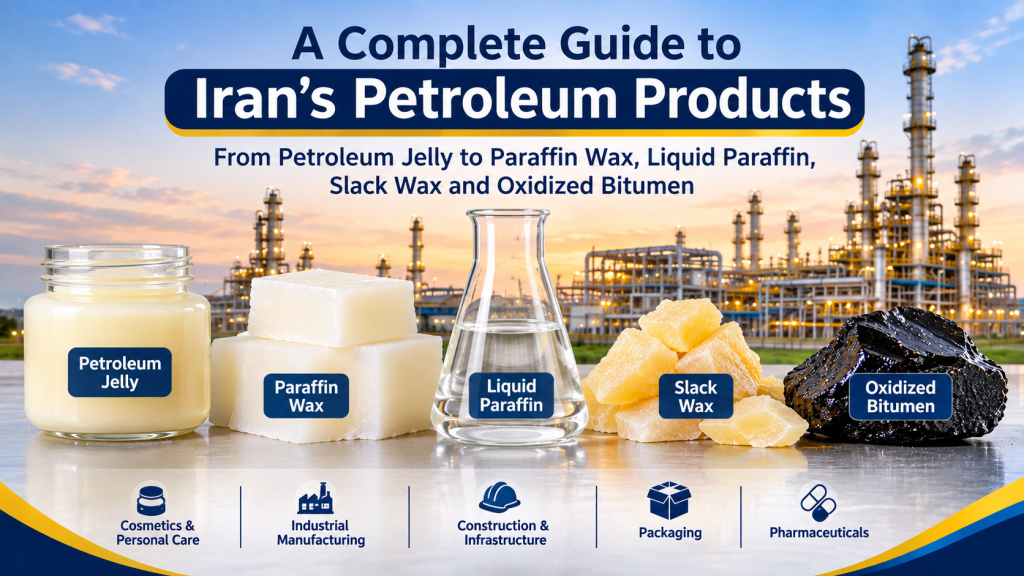
Iran is widely recognized for its oil and gas resources, but the country’s petroleum industry extends far beyond crude oil production. A broad range of refined petroleum derivatives serves manufacturers across cosmetics, pharmaceuticals, construction, packaging, textiles, and numerous other industries. Among these materials are paraffin wax, petroleum jelly, liquid paraffin, slack wax, and oxidized bitumen.
These products differ considerably in their physical properties, production processes, and end uses. Some are refined to achieve a high level of purity for personal care and pharmaceutical applications, while others are primarily valued as industrial raw materials or construction materials.
For international buyers, understanding the characteristics of Iran’s petroleum products is an important step toward identifying suitable materials for manufacturing and commercial distribution. This guide explores the main product categories, their applications, and the role of Iranian suppliers in international petroleum derivatives trade.
1. Beyond Crude Oil – Iran’s Diverse Petroleum Product Portfolio
Iran’s petroleum industry encompasses a variety of products obtained through refining and further processing. Although crude oil remains an important part of the country’s energy sector, downstream activities create materials with applications across a much wider range of industries.
Petroleum derivatives are not all produced in the same way. Some are obtained from specific refinery streams, while others require additional refining, separation, filtration, de-oiling, or chemical treatment to achieve their commercial specifications.
Among the important petroleum-derived products associated with Iran’s industrial and export markets are:
Petroleum Jelly: A semi-solid hydrocarbon material used in cosmetics, personal care, and pharmaceutical formulations.
Paraffin Wax: A solid petroleum-derived wax widely used in candles, packaging, cosmetics, and industrial manufacturing.
Liquid Paraffin: A refined mineral oil available in different grades for industrial, cosmetic, and certain regulated applications.
Slack Wax: An intermediate wax material used in further refining and various industrial processes.
Oxidized Bitumen: A modified petroleum bitumen used in waterproofing, roofing, insulation, and construction.
The diversity of this product range reflects the importance of downstream petroleum processing. Rather than serving only as an energy source, petroleum can also become a valuable industrial raw material.
2. From Solid Waxes to Semi-Solid Materials – Understanding the Product Range
One of the most interesting characteristics of petroleum derivatives is the variety of physical forms they can take. Depending on their molecular composition, refining process, and final specifications, these materials can be solid, semi-solid, or liquid.
Petroleum waxes generally consist of hydrocarbon compounds that crystallize at relatively low temperatures. Their melting characteristics, oil content, hardness, and color determine their suitability for different applications.
Paraffin wax is a solid material with a crystalline structure, whereas slack wax contains a greater proportion of residual oil and is generally softer. Petroleum jelly, on the other hand, has a semi-solid consistency and is formulated through refining and blending processes.
Liquid paraffin differs from these products because it remains fluid under normal ambient conditions. It is valued for its stability, lubricating properties, and versatility.
These differences are important when selecting raw materials. Two products may originate from petroleum refining but cannot necessarily replace one another in manufacturing. Their performance depends on specific technical characteristics rather than simply their petroleum origin.
3. Petroleum Jelly and Its Place in the Global Cosmetics Industry
Petroleum jelly, also known as petrolatum or Vaseline, is one of the most recognizable petroleum-derived materials in the personal care industry. Its smooth consistency, moisture-retaining properties, and protective characteristics make it a valuable ingredient in many cosmetic and pharmaceutical formulations.
It is produced through the refining and purification of suitable petroleum fractions. The final material can vary in color, consistency, purity, and other physical properties depending on the manufacturing process and intended application.
Different Grades of Petroleum Jelly
Petroleum jelly is commonly available in several grades, including:
White Petroleum Jelly
White petroleum jelly is a refined product used in cosmetic formulations, personal care products, creams, lotions, and other applications where a light-colored petrolatum is required.
Snow White Petroleum Jelly
Snow white petroleum jelly is characterized by its bright white appearance. Its color and consistency make it suitable for applications where product appearance is an important consideration.
Ultra Snow White Petroleum Jelly
Ultra snow white petroleum jelly is a highly refined, visually bright grade intended for applications requiring a particularly clean and uniform appearance. Its suitability for a specific formulation depends on its technical specifications and applicable quality requirements.
Pharma Grade Petroleum Jelly
Pharmaceutical-grade petroleum jelly is manufactured and tested according to relevant pharmaceutical quality standards. It is used in certain topical preparations and pharmaceutical formulations, subject to the requirements of the applicable pharmacopeia and regulatory framework.
Applications Across Different Industries
The demand for petroleum jelly comes from several manufacturing sectors:
Cosmetics and skincare products
Moisturizing creams and lotions
Pharmaceutical ointments
Personal care formulations
Protective skin products
Industrial formulations requiring a semi-solid petroleum base
Iran petroleum jelly is an important product category for international B2B buyers looking for refined petrolatum in different commercial grades. When evaluating suppliers, buyers should pay attention to color, consistency, penetration, purity, odor, and relevant quality documentation.
4. Paraffin Wax – A Key Material for Modern Manufacturing
Paraffin wax is among the most versatile products in the petroleum derivatives market. It is a solid hydrocarbon material obtained through the refining and dewaxing of petroleum fractions.
Its relatively low melting temperature, water-repellent properties, chemical stability, and ability to form a smooth surface make it suitable for numerous industrial applications.
Fully Refined and Semi-Refined Paraffin Wax
Paraffin wax is generally classified according to its refining level and residual oil content.
Fully Refined Paraffin Wax
Fully refined paraffin wax undergoes additional purification and de-oiling processes to achieve low oil content, improved color, and a cleaner appearance. It is commonly selected for candles, cosmetics, packaging, and applications where a refined wax is required.
Semi-Refined Paraffin Wax
Semi-refined paraffin wax retains a higher proportion of oil than fully refined grades. It is often used in industrial manufacturing, candle production, and applications where the required specifications do not demand the same level of refinement.
The appropriate grade depends on the intended application rather than the refining level alone.
Where Is Paraffin Wax Used?
Paraffin wax has a broad range of industrial applications:
Candle manufacturing: Provides the main wax base for many conventional candles.
Packaging: Used as a moisture-resistant coating for certain paper and packaging materials.
Cosmetics: Incorporated into creams, balms, and selected personal care formulations.
Textiles: Used in finishing processes and protective treatments.
Rubber and industrial manufacturing: Applied in selected processing and formulation processes.
Polishes and coatings: Provides surface protection and a smooth finish.
Iran paraffin wax is traded internationally in different specifications. Buyers typically evaluate melting point, oil content, color, odor, and congealing characteristics before selecting a grade.
5. Liquid Paraffin Across Industrial and Personal Care Markets
Liquid paraffin, also known as mineral oil or white oil in certain commercial contexts, is a refined petroleum-derived liquid. Its characteristics include low volatility, lubricating properties, and chemical stability.
Unlike paraffin wax, which is solid at room temperature, liquid paraffin remains fluid. This makes it suitable for applications where a stable mineral oil is required.
Understanding Different Liquid Paraffin Grades
The main commercial categories include:
Industrial Grade Liquid Paraffin
Industrial-grade liquid paraffin is used in manufacturing processes where its lubricating, insulating, or formulation properties are required. Applications may include industrial lubrication, textile processing, selected manufacturing operations, and other technical uses.
Cosmetic Grade Liquid Paraffin
Cosmetic-grade liquid paraffin is refined for use in personal care and cosmetic formulations. It can be found in creams, lotions, massage oils, and skincare products where mineral oil is an appropriate ingredient.
Food Grade Liquid Paraffin
Food-grade liquid paraffin is intended for specific applications where the relevant food-grade purity and regulatory requirements are met. It should not be confused with ordinary industrial or cosmetic mineral oil. Buyers must verify applicable certifications, permitted uses, and local regulations before purchasing this grade.
Important Specifications for Buyers
When sourcing Iran liquid paraffin, buyers should consider:
Kinematic viscosity
Density
Color and appearance
Flash point
Purity and refining level
Relevant regulatory and quality documentation
Choosing the correct grade is essential because industrial, cosmetic, and food-related applications have different technical and regulatory requirements.
6. Slack Wax as a Raw Material for Further Processing
Slack wax is an intermediate petroleum-derived material obtained during the dewaxing of lubricating oil fractions. It generally contains a mixture of paraffin wax and residual oil, giving it a softer consistency than refined paraffin wax.
Unlike fully refined paraffin wax, slack wax has not undergone the same level of de-oiling and purification. Its oil content, color, melting characteristics, and consistency can vary depending on the source and production process.
Why Is Slack Wax Important?
Slack wax is particularly valuable because it serves as a raw material for further processing. Through additional de-oiling and refining, it can be converted into higher-refined wax products.
Its industrial applications include:
Production of semi-refined and refined paraffin wax
Candle manufacturing
Wax emulsions
Waterproofing formulations
Polishes and protective coatings
Selected textile and industrial applications
For manufacturers, slack wax can offer an economical starting material for producing wax-based products.
When sourcing slack wax from Iran, buyers should examine oil content, melting point, color, and consistency. These parameters help determine whether the material is appropriate for further refining or direct industrial use.
7. Oxidized Bitumen in Construction and Infrastructure
Oxidized bitumen, also known as blown bitumen, is a modified petroleum material produced by passing air through heated bitumen under controlled conditions.
This process changes the physical properties of the original bitumen, generally increasing its softening point and producing a harder material with different penetration and temperature characteristics.
Unlike conventional paving bitumen, oxidized bitumen is particularly valued in applications where resistance to heat, water, and environmental exposure is important.
Common Grades of Oxidized Bitumen
Oxidized bitumen is commonly classified using penetration and softening point values. Commercial grades include 75/25 and 115/15, among others.
The numbers represent the specified penetration and softening point characteristics under the applicable testing methods.
Different grades are selected according to the performance requirements of the final application.
Industrial and Construction Applications
Oxidized bitumen is widely used in:
Roofing and waterproofing membranes
Building insulation
Pipe coating
Protective coatings
Roofing compounds
Industrial sealing materials
Construction and infrastructure products
Its ability to provide water resistance and maintain suitable physical characteristics under different temperature conditions makes it a useful material for construction-related manufacturing.
International buyers sourcing oxidized bitumen should verify penetration, softening point, ductility where applicable, flash point, and packaging specifications.
8. Where Iranian Petroleum Products Find International Demand
The international market for petroleum derivatives is closely connected to manufacturing activity. As industries expand, their demand for specialized raw materials also changes.
Iranian petroleum products serve different commercial markets because each material has its own applications and customer base.
Paraffin wax, for example, is relevant to candle manufacturers, packaging producers, and industrial wax processors. Petroleum jelly is more closely associated with cosmetic, personal care, and pharmaceutical manufacturers. Liquid paraffin serves industrial and personal care markets, while slack wax is particularly relevant to companies involved in further wax processing.
Oxidized bitumen has a different market structure, with demand coming primarily from waterproofing manufacturers, construction material producers, and industrial coating companies.
Iran’s paraffin wax exports provide a measurable example of this international trade activity. According to World Bank World Integrated Trade Solution (WITS) data, Iran exported approximately 57.85 million kilograms of paraffin wax containing less than 0.75% oil in 2023, with India, Turkey, Pakistan, the United Arab Emirates, and Tanzania among its reported destinations.
This demonstrates the importance of international markets for Iranian petroleum-derived materials.
For buyers, the most suitable sourcing destination depends on several factors, including product specifications, available quantities, production consistency, transportation arrangements, and import requirements.
9. Understanding the Differences Between Major Petroleum Products
Although these materials share a petroleum origin, their physical characteristics and commercial purposes are quite different.
Understanding these differences helps manufacturers avoid selecting unsuitable raw materials.
| Product | Physical Form | Main Characteristics | Common Applications |
|---|---|---|---|
| Petroleum Jelly | Semi-solid | Smooth consistency, protective properties | Cosmetics, personal care, pharmaceuticals |
| Paraffin Wax | Solid | Crystalline structure, defined melting range | Candles, packaging, cosmetics |
| Liquid Paraffin | Liquid | Lubricating properties, low volatility | Industrial processes, personal care |
| Slack Wax | Soft solid | Higher residual oil content | Wax refining, candles, industrial uses |
| Oxidized Bitumen | Solid or semi-solid | Higher softening point, water resistance | Roofing, waterproofing, insulation |
The distinction between these products is not simply a matter of appearance.
For example, paraffin wax and slack wax are both petroleum-derived wax materials, but their different oil contents make them suitable for different stages of manufacturing. Similarly, petroleum jelly and liquid paraffin may both be used in cosmetic formulations, yet their different physical consistencies mean they serve different formulation purposes.
For industrial buyers, the most effective approach is to compare technical specifications with the requirements of the final product rather than relying solely on product names.
10. Iran’s Role in the International Petroleum Derivatives Trade
Iran’s petroleum industry provides access to a range of refinery-derived materials that serve both domestic manufacturers and international buyers.
The country’s position in regional trade, together with its petroleum processing capabilities, has contributed to the presence of Iranian petroleum products in international markets.
However, the success of an export transaction depends on more than the availability of a product. Buyers need suppliers who understand international trade requirements and can provide consistent specifications, suitable packaging, and the necessary commercial documentation.
What International Buyers Should Look For
Selecting a reliable petroleum products supplier involves evaluating several important factors:
1. Consistent Product Quality
Specifications should be clearly defined, and supplied products should correspond to the agreed technical requirements.
2. Technical Documentation
Depending on the product, buyers may require a Certificate of Analysis (COA), Technical Data Sheet (TDS), and Safety Data Sheet (SDS).
3. Suitable Packaging
Packaging should be appropriate for the physical characteristics of the product, storage conditions, transportation method, and destination market.
4. Supply Capacity
Suppliers should be able to clarify available quantities, production schedules, and their ability to fulfill repeat orders.
5. Export Experience
International transactions require attention to documentation, customs procedures, transportation, and destination-country regulations.
For companies interested in sourcing petroleum derivatives from Iran, working with an experienced supplier can simplify communication and help establish more reliable purchasing arrangements.
Faragam Paraffin focuses on supplying petroleum-derived products to international B2B customers. Its product portfolio includes petroleum jelly, paraffin wax, liquid paraffin, slack wax, and other petroleum-based materials for different industrial and commercial requirements.
By understanding the specifications and intended applications of each product, Faragam Paraffin aims to support buyers in identifying suitable materials for their markets.
11. The Future of Iran’s Petroleum Derivatives Market
The future of the petroleum derivatives industry will depend not only on crude oil production but also on the ability to manufacture refined materials that meet changing industrial requirements.
Several factors are likely to influence demand for these products in the coming years.
Growing Demand for Specialized Raw Materials
Manufacturers increasingly require materials with specific physical and technical properties. This creates opportunities for refined petroleum products designed for particular industrial applications.
Expansion of Personal Care and Cosmetic Manufacturing
Petroleum jelly and cosmetic-grade liquid paraffin continue to serve as important ingredients in selected personal care formulations. Product quality, consistency, and regulatory compliance will remain essential considerations for manufacturers.
Industrial Applications of Petroleum Waxes
Paraffin wax and related materials are expected to remain relevant in candle production, packaging, coatings, and other manufacturing processes. Their performance characteristics make them useful across multiple industries.
Importance of Product Quality and Refining
As international buyers become more selective, suppliers will need to focus on consistent specifications, appropriate refining processes, and reliable quality documentation.
Development of International Trade Relationships
Long-term business relationships, transparent commercial communication, and dependable supply arrangements will remain important in the international petroleum derivatives market.
Iran’s petroleum derivatives industry has opportunities to serve a diverse range of international customers. For suppliers and manufacturers, the ability to match product specifications with market requirements will be an important factor in maintaining competitiveness.
Final Thoughts
Iran’s petroleum products represent a diverse group of materials with applications extending far beyond the traditional energy sector. From petroleum jelly used in personal care formulations to paraffin wax in manufacturing, liquid paraffin in industrial processes, slack wax in further refining, and oxidized bitumen in construction, each product serves a distinct commercial purpose.
For international buyers, understanding these differences is essential when evaluating suppliers and selecting appropriate raw materials.
As global manufacturing continues to evolve, the demand for reliable petroleum derivatives and consistent product quality will remain important. Working with knowledgeable Iranian suppliers can help international businesses access suitable products and develop long-term commercial partnerships.