
Paraffin Wax For Food Industry
Paraffin Wax For Food Industry: Applications and Nuances
Today, paraffin wax in the food industry finds itself at the intersection of tradition and innovation. Its diverse applications in the modern food sector are a testament to its sustainable use, ensuring fresh, safe, and high-quality food products reach consumers.
Paraffin Wax For Food Industry: Origin and Characteristics
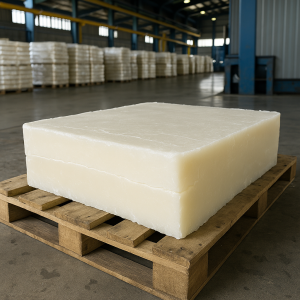
A familiar name across various industries, paraffin wax originates from crude oil through refining processes. When crude oil undergoes distillation, numerous hydrocarbon chains are created. Among these, paraffin wax stands out as a white or colorless solid, often recognized for its transparency when light shines through a thin sheet. Tracing back to the early 1850s, this versatile substance initially gained prominence in candle making before expanding into other areas, including the food industry.
Paraffin Wax For Food Industry: Chemical Structure
At the molecular level, paraffin wax comprises saturated hydrocarbons, predominantly straight-chain alkanes. The chain length generally spans twenty to thirty carbon atoms. This chain length and specific saturation provide paraffin with unique attributes, such as a relatively elevated melting point and its solid state at room temperature.
Paraffin Wax For Food Industry: Physical Properties
Melting Point: Paraffin wax typically has a melting point ranging from 46 to 68 degrees Celsius (approximately 115 to 154 degrees Fahrenheit), dictated by the precise composition of hydrocarbons and their chain lengths.
Density: Its density is less than that of water, allowing it to float. This property proves particularly beneficial in applications like candle production. Transparency: In thin sheets, the wax exhibits translucence, a characteristic that has made it a sought-after component in some artistic and commercial uses.
Insolubility: Paraffin wax is insoluble in water but soluble in ether, benzene, and certain esters. This characteristic is vital when considering its roles in the food industry, where it serves as a moisture barrier.
Applications in the Food Industry:
While it may seem that paraffin wax has a small share in the food industry, its significance in preserving and protecting various food items should not be disregarded. Its water-repellent properties make it an ideal coating for fruits, cheeses, and candies, ensuring extended shelf life and freshness. Furthermore, its inertness means it doesn’t react with food, assuring safety and flavor preservation.
Understanding the origin and properties of paraffin wax unlocks insights into its broader applications, particularly within the food industry. From safeguarding against external elements to maintaining the aesthetic appeal of food products, paraffin wax has established itself as an indispensable asset.
Paraffin Wax For Food Industry: Coating(Extending Product Longevity)
The food industry continually seeks ways to maximize product shelf life without compromising quality. Enter paraffin wax coating – a process that not only preserves the product’s freshness but also enhances its visual allure.
The Science Behind Wax Coating:
At its core, paraffin wax is a mixture of hydrocarbons derived from petroleum, coal, or shale oil. Its molecular structure makes it an ideal candidate for forming protective coatings. When applied to a product, it creates a thin, breathable layer that regulates moisture loss, gas exchange, and microbial growth – all factors that contribute to product spoilage.
contents on this page